The Science of Sound and Music

Gilbert, AZ, April 26, 2020 at 17:09
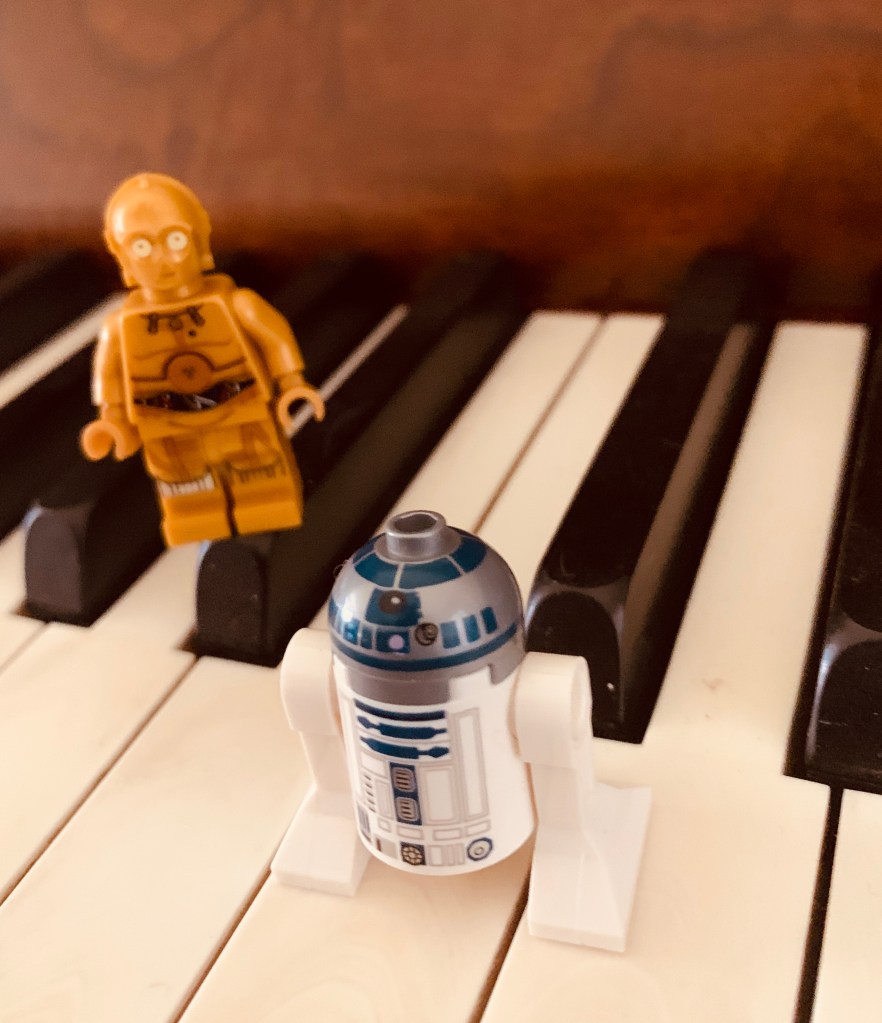
When you hear a tune on the piano you are actually listening to the sound of the strings vibrating back and forth. This vibration produces sound waves, which are longitudinal waves that travel through a medium such as, air and water. It is more easily noticeable on a guitar since you can see the strings vibrating when plucked.

These sound waves can be measured using a variety of different instruments. These instruments count the number of sound waves produced in a second and displays that information as Hertz (Hz), also known as frequency. The human ear can perceive sound from about 20 Hz to 20,000 Hz. The lower the frequency the lower the tone such as bass notes. The higher the frequency, the higher the tone such as, a soprano singer. In western music there are 12 frequencies called notes or tones. After the 12 tones, the notes are repeated at double the frequency. This is called an octave. For example, the note of middle C on the piano vibrates at 261.6 Hz. Its octave, (12 notes above) is also a C vibrating at exactly double the frequency of 523.2 Hz. An 88 key piano spans 7 octaves. Julie Andrews, from the Sound of Music, has a vocal range of 4 octaves.

Did you know, how fast sound travels? Sound travels at about 760 mph. This is much slower than the speed of light, which travels at about 671,000,000 mph. This is why, when you are at a baseball game sitting in the outfield, you see the batter swing and hit the ball and seconds latter you hear the smack of the bat.
States of Matter

Gilbert, AZ, April 26th at 09:45

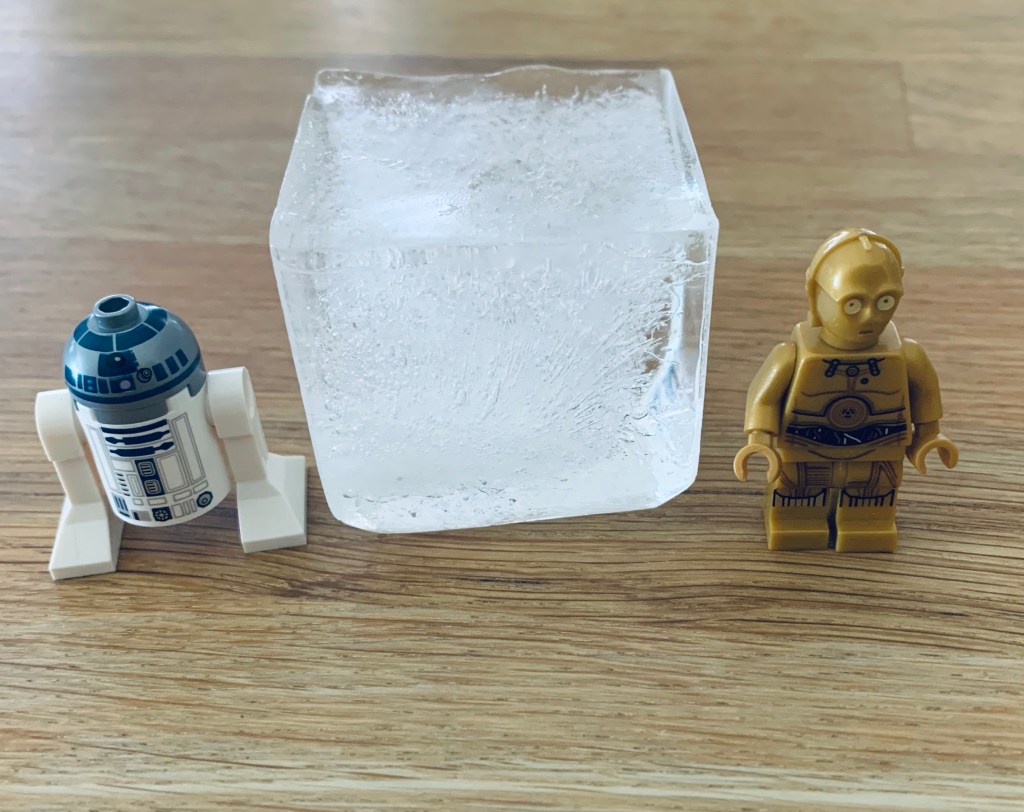
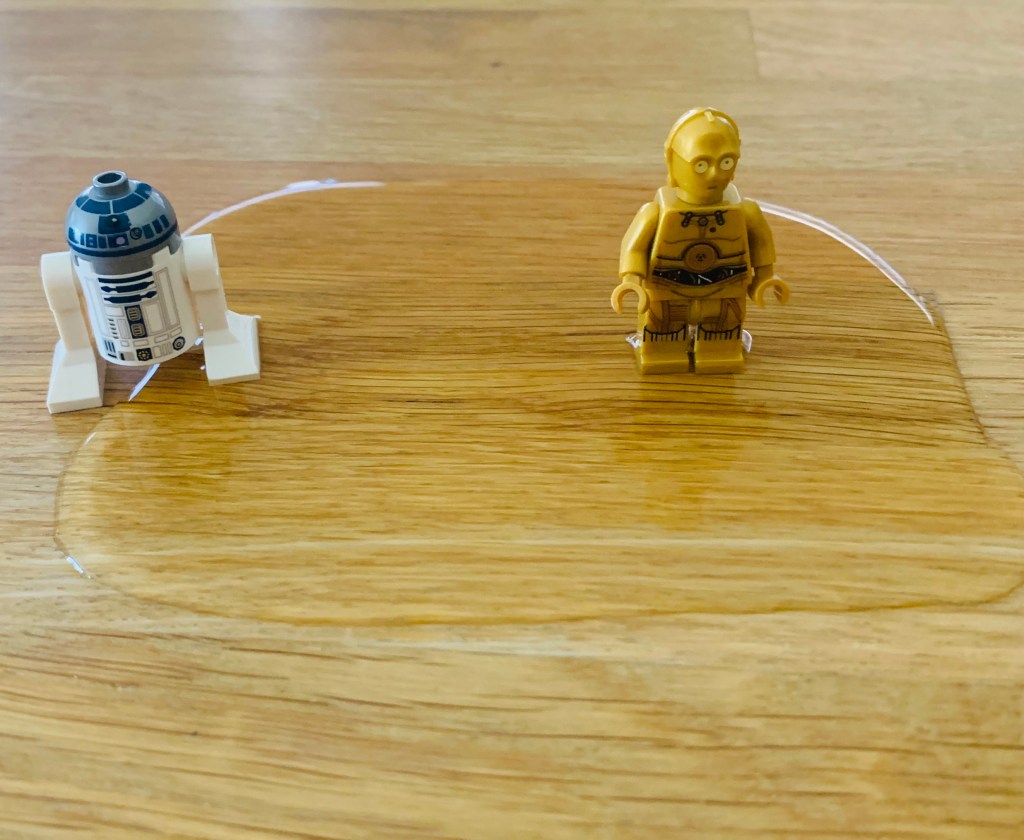
Matter is any substance that has mass and takes up space by having volume. There are three states of matter: solid, liquid and gas. Water is very unique in that it can exist in all three states of matter. When water is cooled down below 32ºF or 0ºC it freezes into a solid, also known as ice (pictured above). Here I am standing in water in its liquid state at room temperature (pictured below).

When you apply heat to water and it reaches 212ºF or 100ºC, water can transform into steam, a form of its gas state, called water vapor. When something is solid, the tiny molecules it is made up of are tightly packed together. When it is in a liquid state, the molecules are little more spread out, allowing it to ebb and flow like water. When it is in its gas state, the molecules are spread out the most.

Did you know, how much energy it takes to turn water into steam? To convert 1 gallon of water at its boiling point of 100ºC into 1 gallon of steam, will require 2,260 Joules of heat to be absorbed by the water.

Fossils

Gilbert, AZ, April 25, 2020 at 14:07

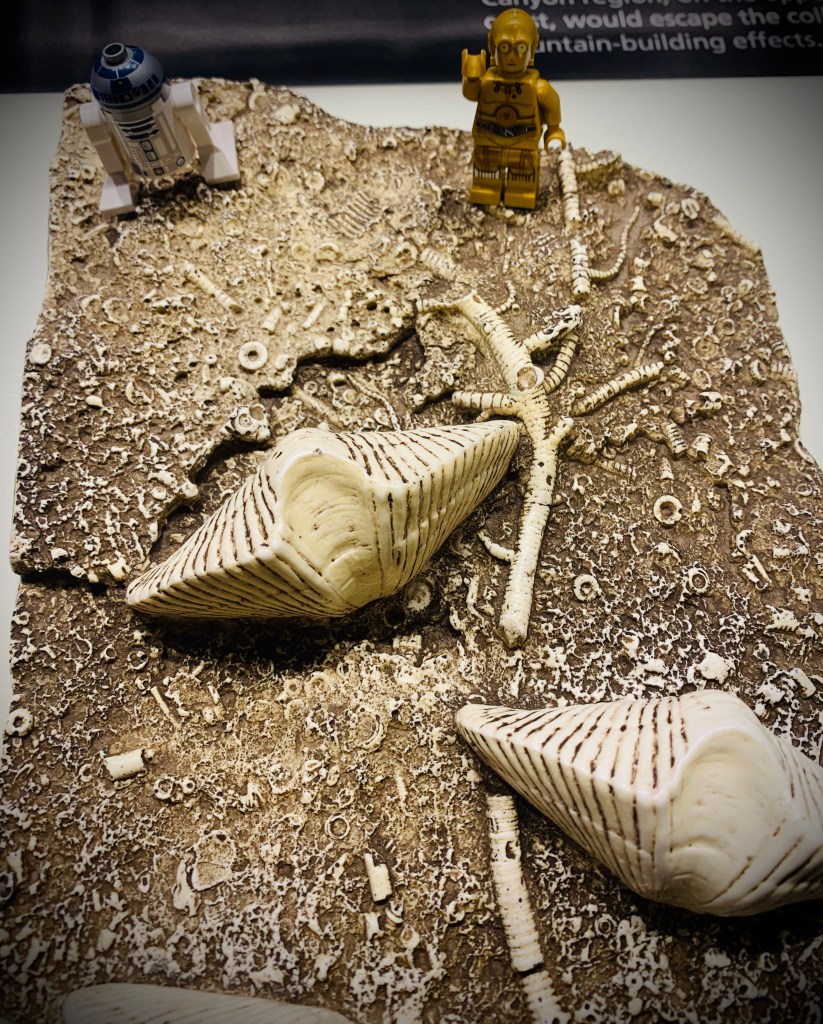
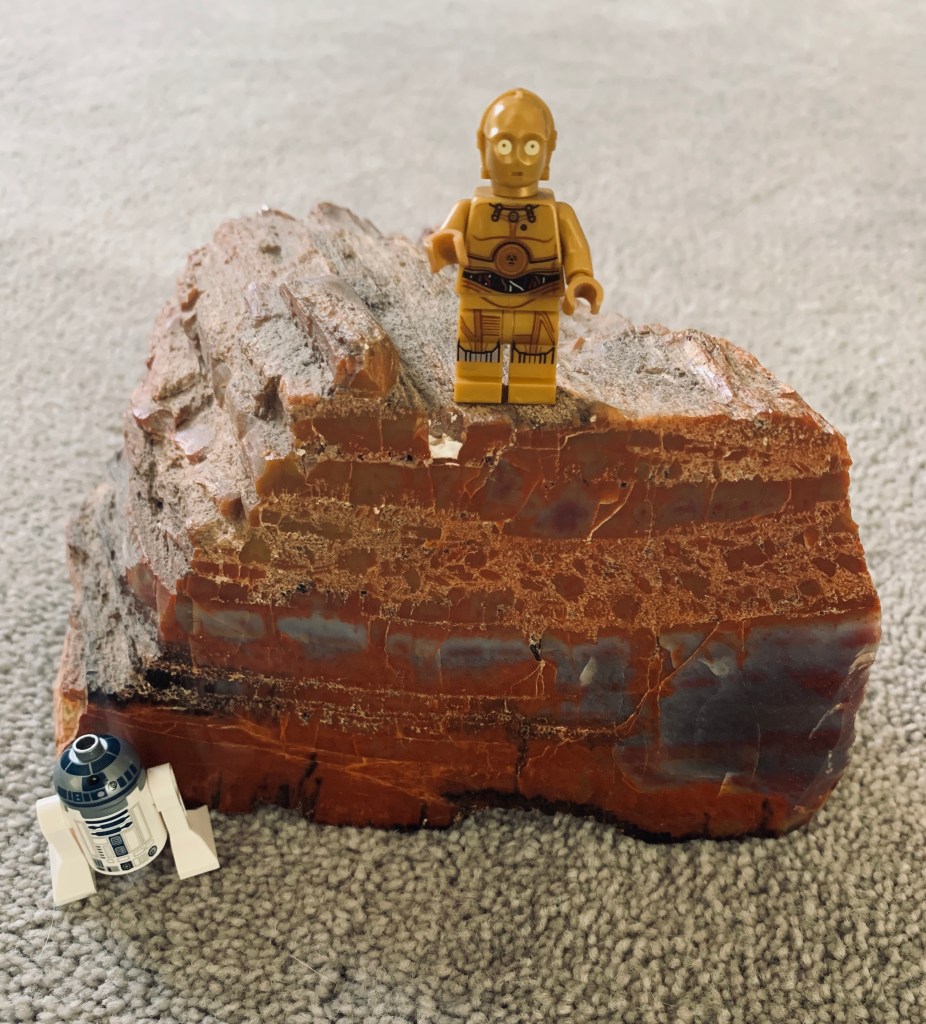
Fossils are the preserved remains or traces of remains, of ancient organisms. Fossils are not the remains of organisms themselves, they are rocks. It takes a long time for preserved remains to become fossils in the process known as fossilization. In the picture below I am standing on a fossil, known as petrified wood.

Fossilization is rare, because most organisms decompose after they die. In order to become fossilized, an organism needs to die and be covered by sediment such as, dirt, sandy sea floor, lava, or tar. Over time minerals in the sediment seep into the remains and the remains become fossilized. Fossilations usually occur with hard bony body parts such as skeltones, teeth or even shells, known as body fossils. Trace fossils are rocks that preserved traces of biological activity such as footprints.

Did you know, how long it takes for organisms to become fossils? Fossils are defined as the remains or traces of organisms that died more than 10,000 years ago. So it takes a minimum of 10,000 years to become a fossil.

Viewing Astronomy through the Hubble Telescope

Gilbert, AZ, April 24, 2020 at 16:34

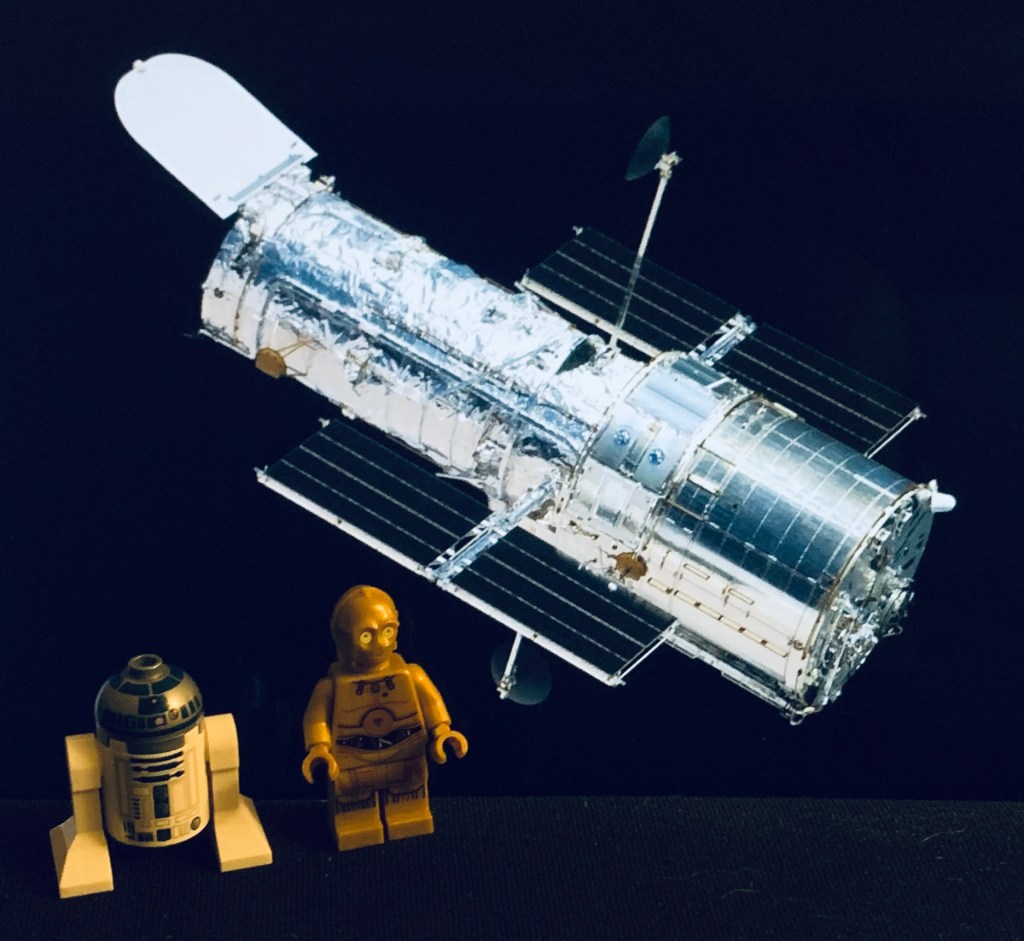
Astronomy is the study of celestial objects in space. Today, 30 years ago, on April 24th the Hubble telescope was launched into space, which helped astronomers see space more easily. It is named after astronomer, Edwin Hubble. It is 43.5 feet long, about the size of a large school bus and weighs 27,000 pounds. It is at a low earth orbit with an altitude of 295 nautical miles. It travels at 17,000 mph and takes about 95 minutes to orbit the Earth. It receives its power from the sun with two 25-foot solar panels. These panels generate about 5,500 watts, although the telescope only uses an average of 2,100 watts. It has 6 nickel-hydrogen batteries to help store the extra power, which it uses when the earth is blocking the sun.

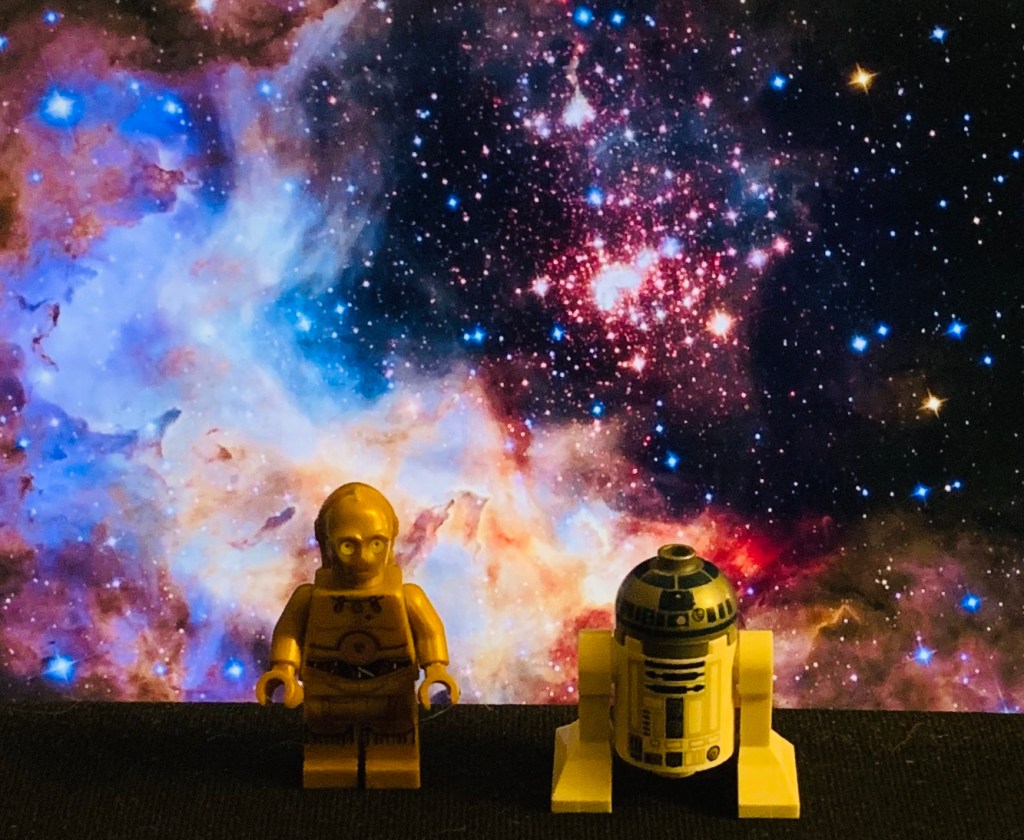
(beep boop beep). That’s right R2 we flew right by this on our way to Earth. This is an image taken by the Hubble telescope. Because of it being in space, it has no atmospheric conditions, such as clouds to obstruct its view.

Did you know, that in order for the Hubble telescope to take pictures of faint objects in space it must be very accurate? The telescope has the pointing accuracy of .007 arcseconds, which is the equivalent of being able to shine a laser beam onto a dime about 200 miles away.

Plant Life

Gilbert, AZ, April 22, 2020 at 16:42

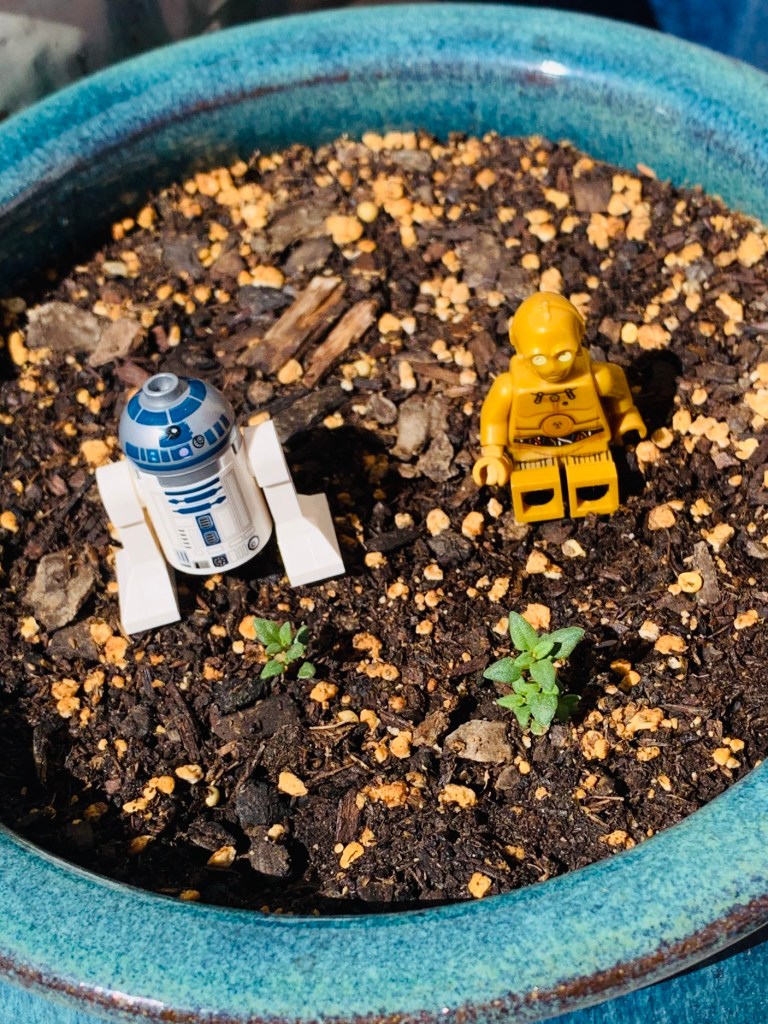
Today is Earth Day and we are going to explore the life cycle of plants. Plants start out in the form of a seed. A seed in the ground that is regularly watered will germinate. Once this happens it starts to grow its taproot downward into the soil. The taproot is the main root that all other roots branch from. It also grows its cotyledons, which are the first set of leaves that emerge above the soil. Pictured above is a plant in its early stages of life.

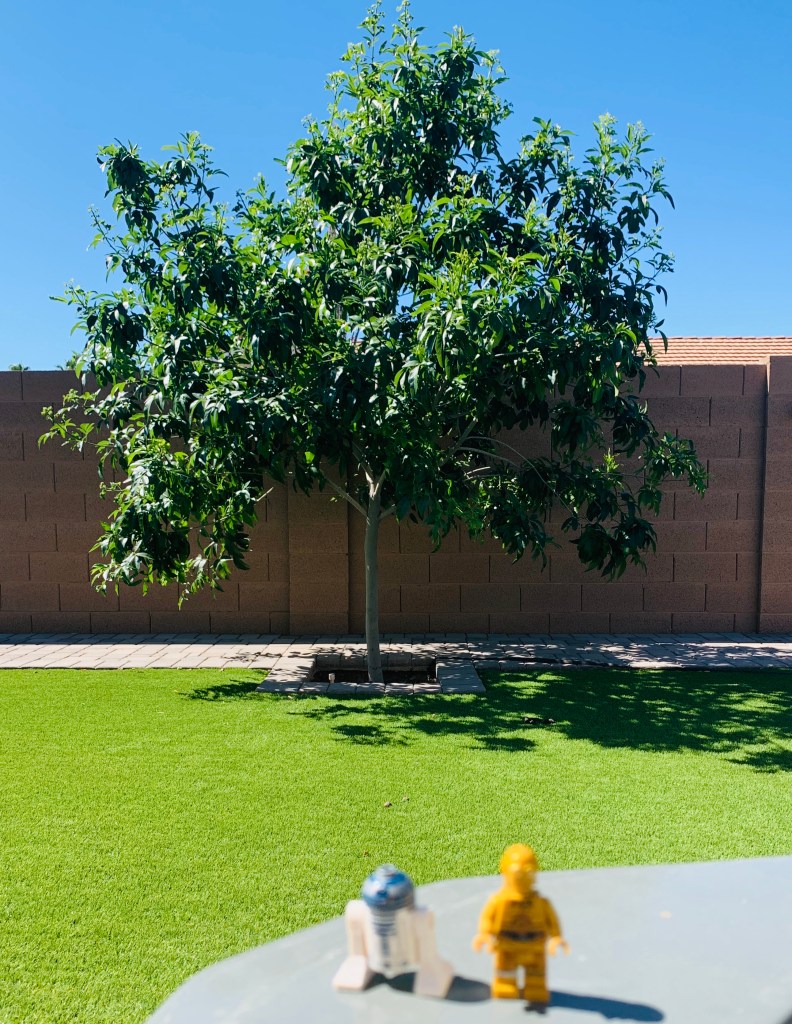
After many years of adequate water and sunlight, that little tiny plant turns into this big tree (pictured above), which contain more seeds in order to reproduce and start the entire process over again. Trees absorb water through its roots. With its leaves, it uses sunlight to produce food (carbohydrates) from water and carbon dioxide and creates a byproduct of oxygen in a process called, photosynthesis.

Did you know, what makes the leaves of a plant green? This is because they contain a pigment called chlorophyll, which absorb blue and red parts of the light spectrum and reflect the green light, making the plant appear green.

Gravity

Gilbert, AZ, April 2, 2020 at 13:46

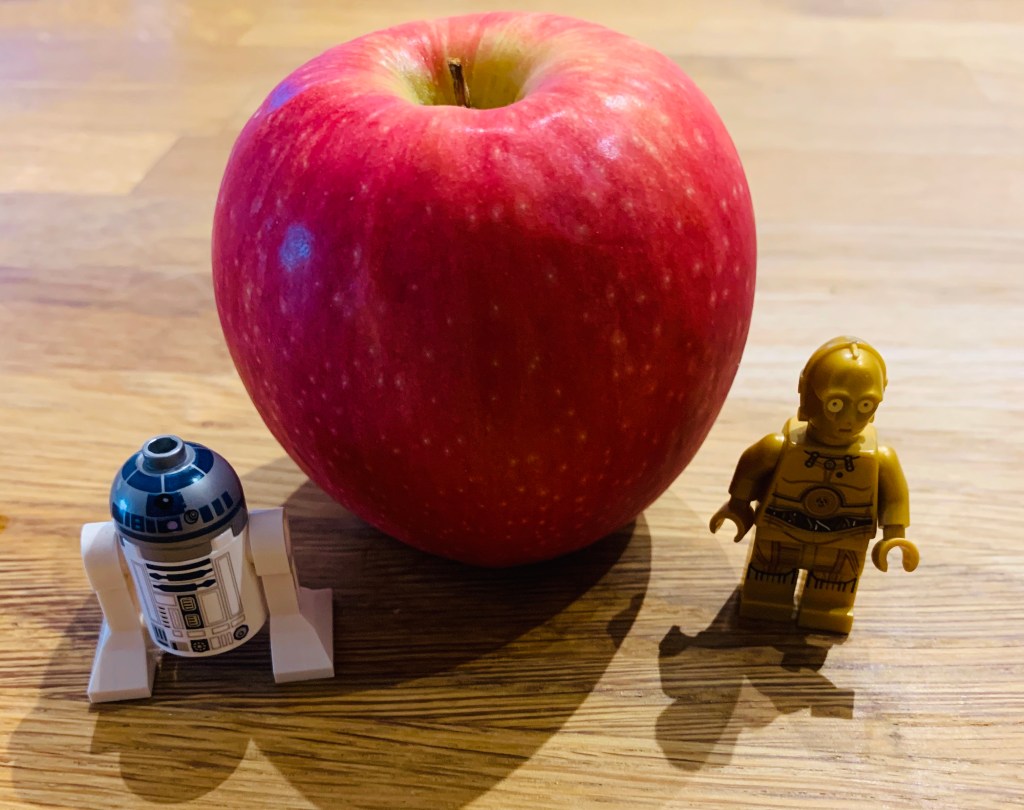
The explanation of gravity all started with an apple. Story goes that Sir Isaac Newton was sitting underneath an apple tree when one fell and hit his head. Contrary to popular belief, truth be told that it didn’t quite hit his head; however, he was observing the apple falling and questioning why it fell to the ground and not upwards. This gave him an “ah-ha” moment and thus the birth of his theory of gravity. He explains that every mass in space attracts every other mass and there is a gravitational force between the two. He used his theory to explain why the moon doesn’t fall towards Earth, nor the Earth towards the sun. He also used this idea to prove Kepler’s theory of planetary motion.

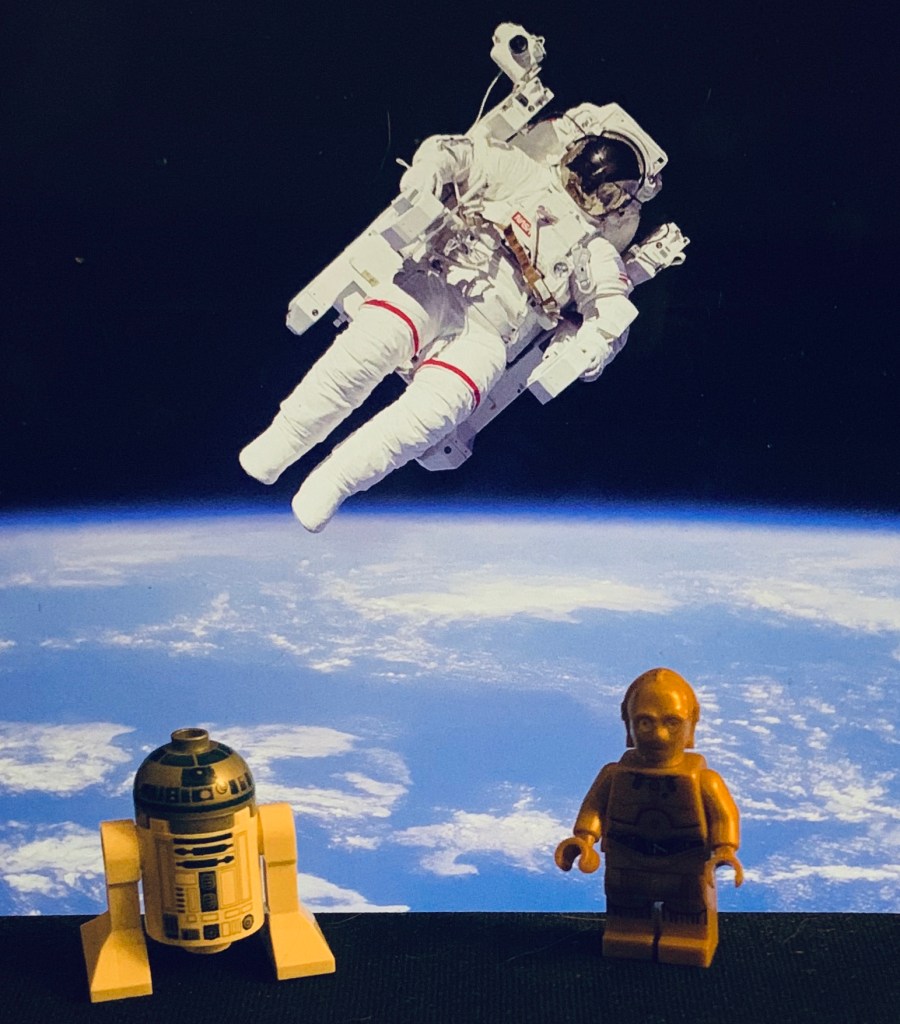
In space there is zero gravity which is why this astronaut floats around and does not fall down to Earth. The moon has less mass than Earth and therefore, the gravity is about 1/6th compared to Earth’s. Newton went on to develop his Laws of Motion, which is enough information to do another blog post.

Did you know, how fast an object must travel to escape Earth’s gravitational pull? The answer is about 25,020 mph, which is called the escape velocity.

Geology

Grand Canyon, AZ March 15, 2020 15:47

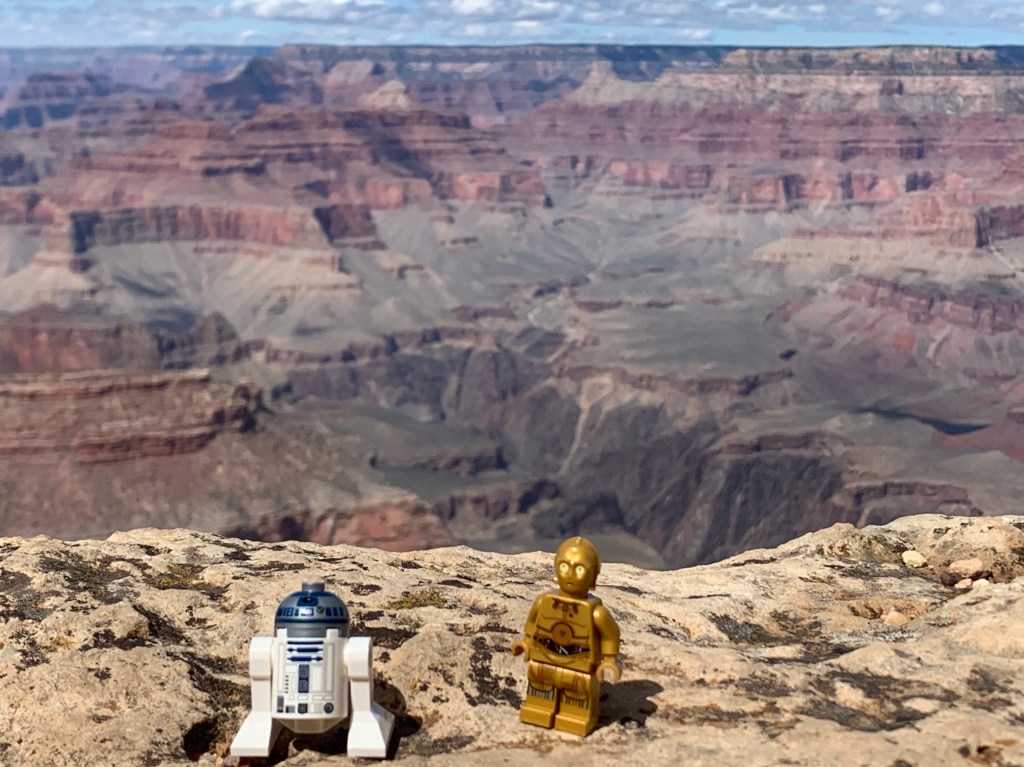
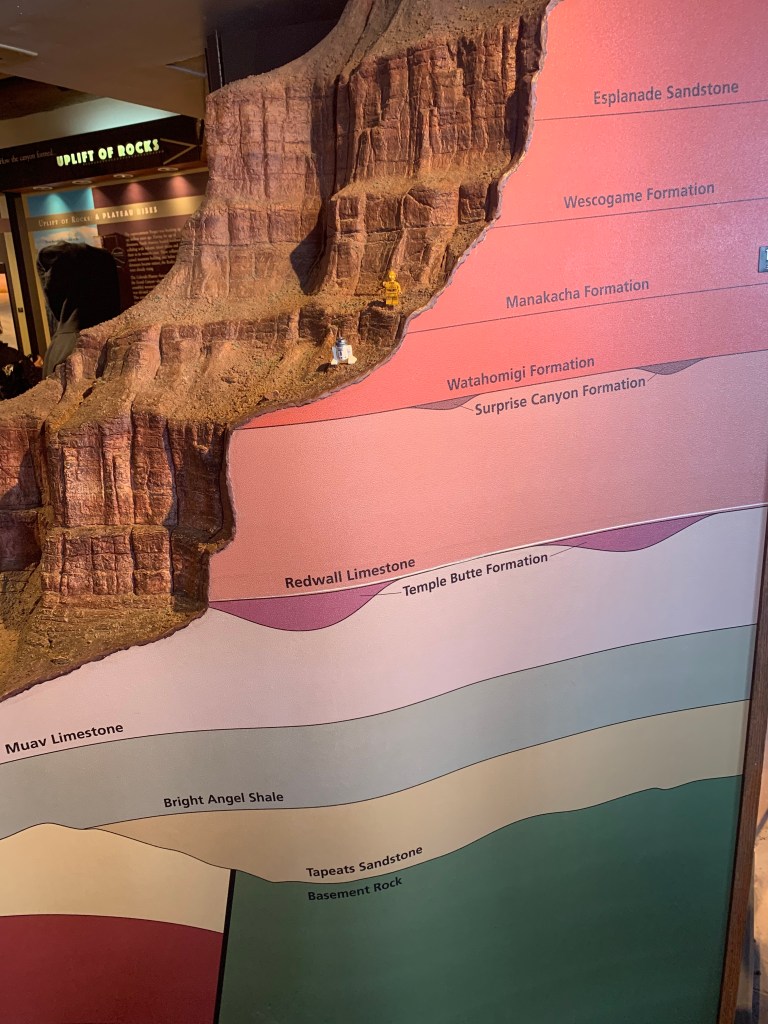
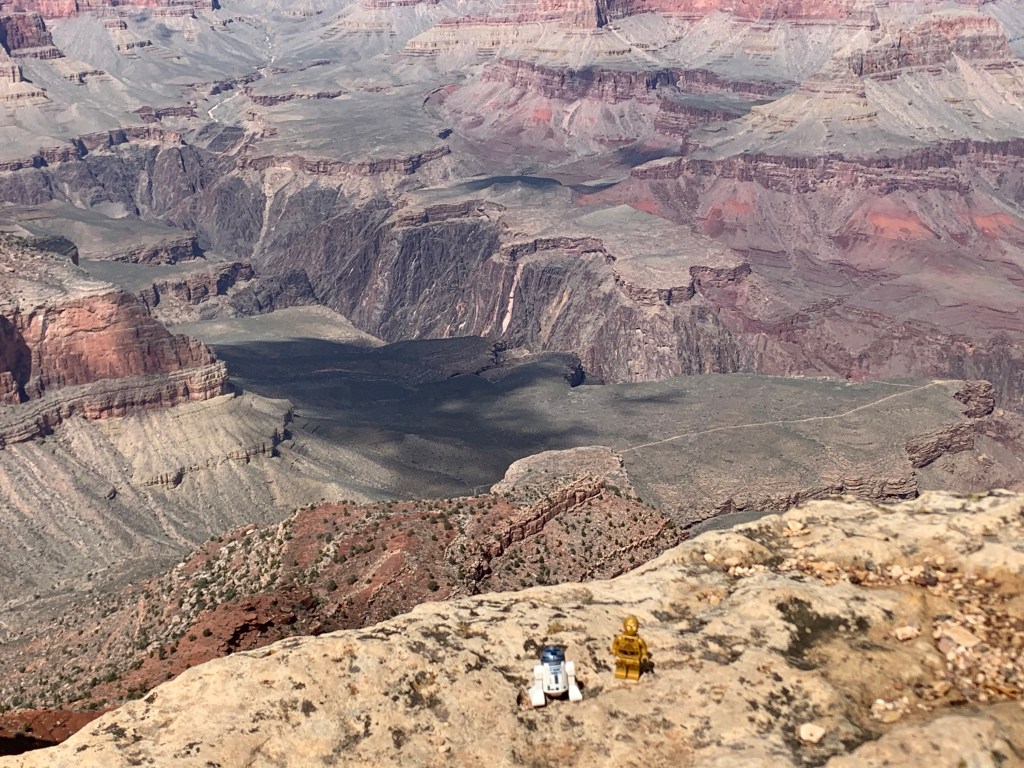
We are back at the Grand Canyon to take a closer look. Geology is the study of the Earth’s physical structure. Geologist love studying the Grand Canyon because the cliff walls expose the different types of rock and soil found throughout the region dating as far back as two billion years ago. Geologist place rocks into three different categories: igneous, metamorphic and sedimentary. The oldest rock on the bottom of the canyon is made up of igneous and metamorphic rocks. Above these are layer upon layer of sedimentary rock. The picture below is an example of a stratigraphic column. Geologist use these diagrams to look at the different rock layers. There I am on the Manakacha formation. (beep boop beep). R2 says he is on the Watahomigi Formation.

These stratigraphic columns show the rock layers with the oldest on the bottom, and the youngest on top. In geology, this is referred to as the principle of superposition, which means the rocks on top are generally younger than rocks below them.

Did you know, how old the youngest rock is at the Grand Canyon? The top layer called the Kaibab Limestone, which is the youngest, is about 270 million years old.

Weathering, Erosion and Deposition

Grand Canyon, AZ March 15, 2020 13:01

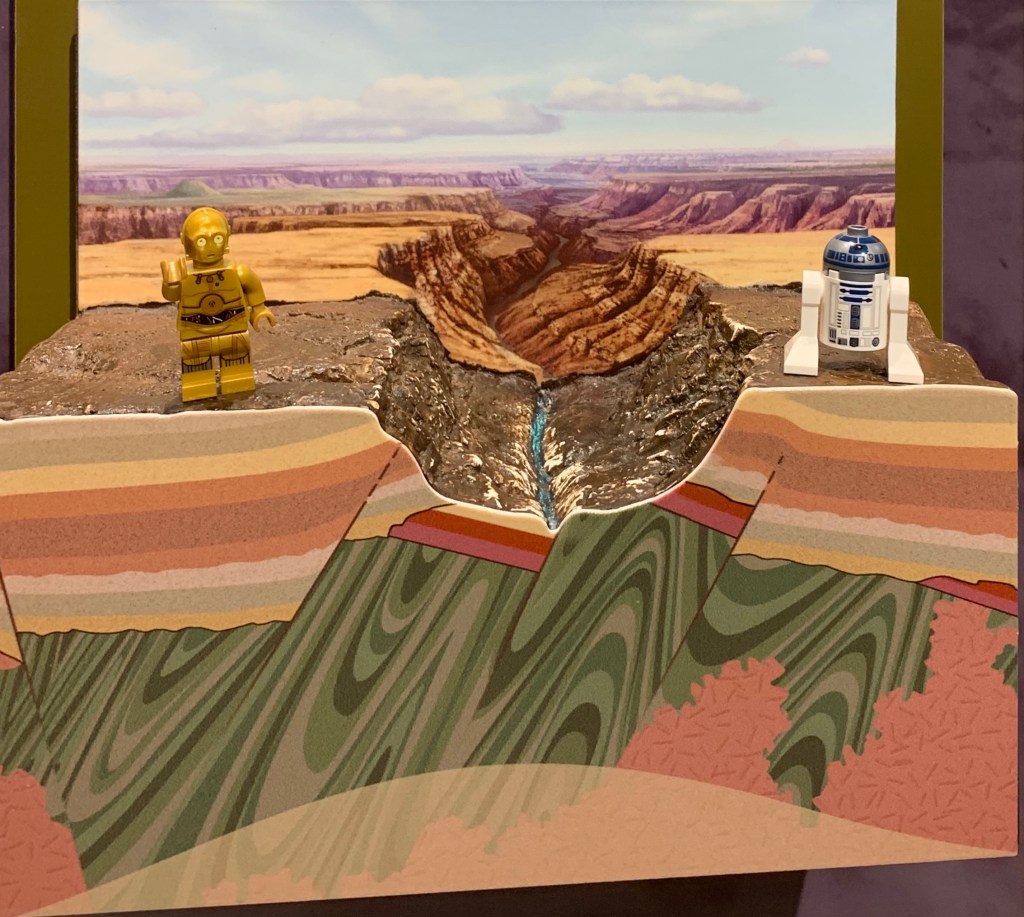
(beep boop beep). No R2, this is not Beggar’s Canyon on Tatooine, this is the Grand Canyon. The Grand Canyon was formed through a process of weathering, erosion and deposition. Weathering, is the process of breaking down rocks and creating sediment. For example, the Grand Canyon is weathered away by wind and rain. Erosion is the process by which natural forces move weathered rock and soil from one place to another. For example, erosion of the Grand Canyon occurs from the Colorado River, that carries the weathered rock away. Once the rock is carried away by the Colorado River it is then perhaps deposited in the Gulf of California where the Colorado River meets the sea. This process is known as deposition.

The process of weathering, erosion and deposition occur over millions of years. Today, these geological forces are still actively sculpting the landscape.

Did you know, how long the process of weathering, erosion, and deposition took to form the Grand Canyon? Scientist have studied rocks at the base of the canyon and estimate it to be 5-6 million years old.

The Moon

ASU, AZ February 6, 2020 @ 15:58

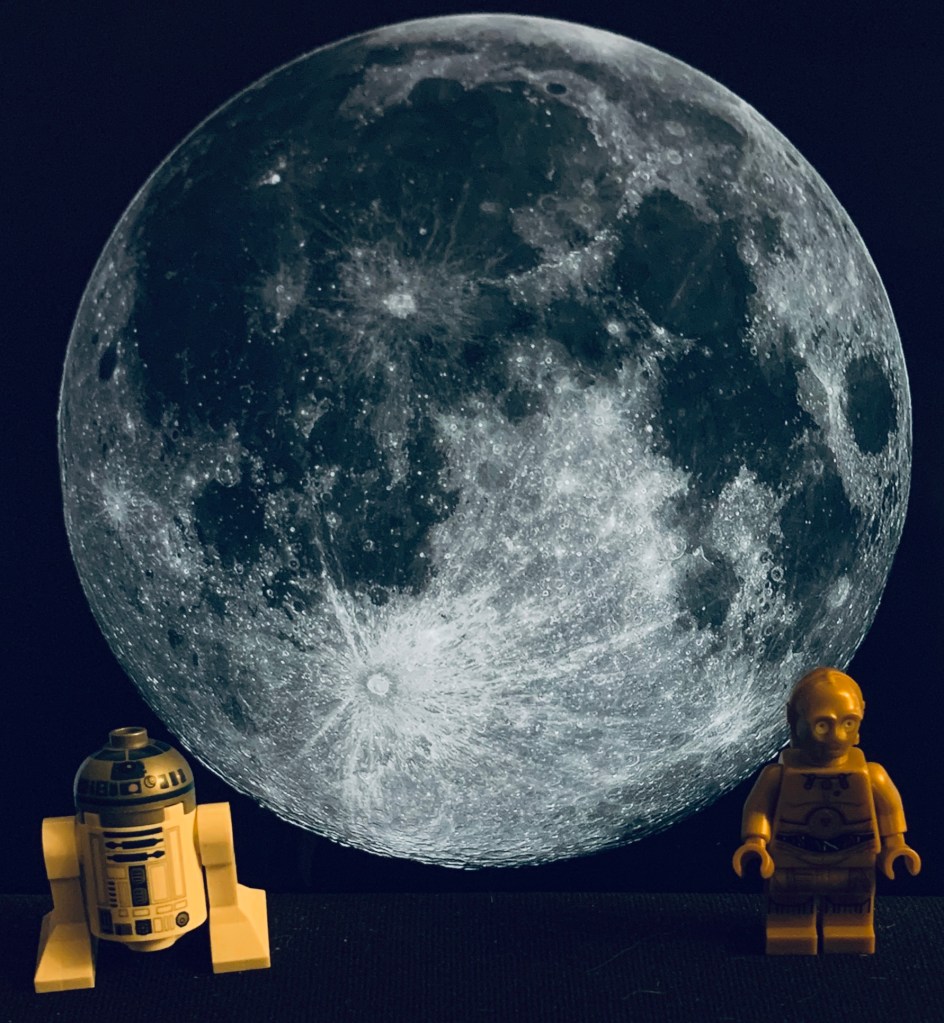
The moon reflects light from the Sun and that is why it glows in the night sky. As the moon rotates around the Earth during its lunar cycle that is when we see the different phases of the moon.

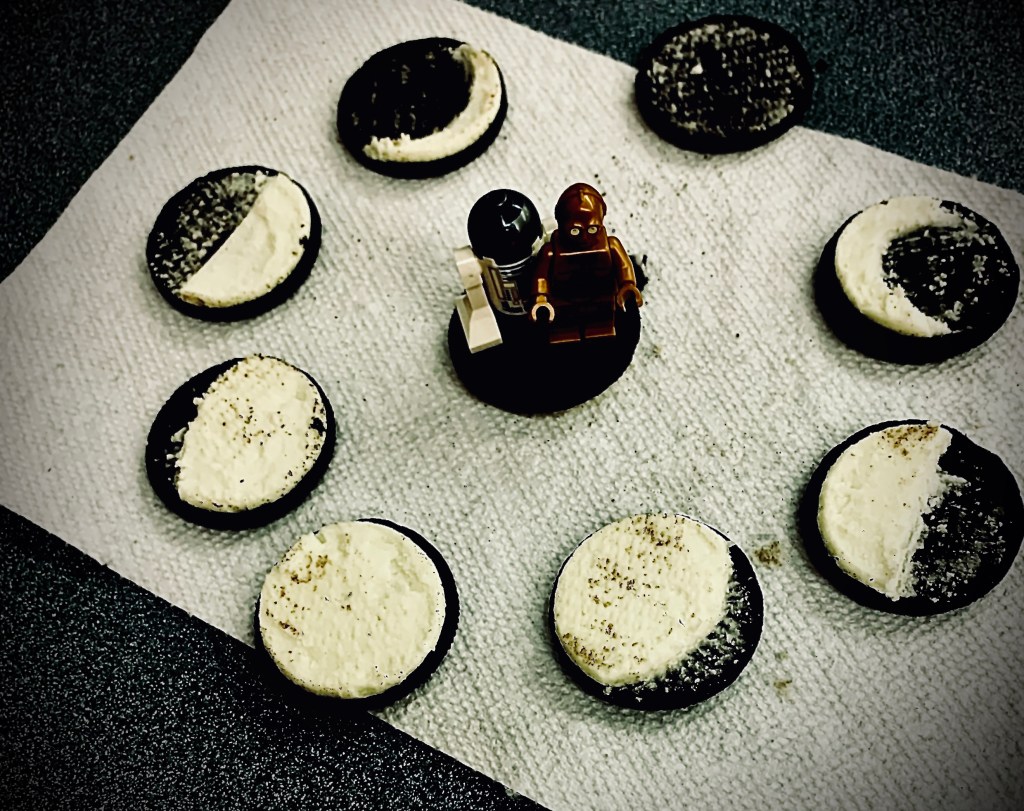
In the picture above, we used Oreo cookies to model the different phases of the moon. If the sun were located behind the cookie with no icing, and we are standing on Earth observing the moon as it rotates around Earth, you can see how the moon takes its different shape. When the Earth is between the sun and the moon, that is when we have a full moon. There are times when the Earth, moon and sun line up exactly and that is when we have eclipses. When the moon nears the full moon and goes away from it we have the gibbous moon, which is like a 3/4 moon. When the Moon is 90º from the sun and the Earth, we see the quarter moon. When the moon is between the Earth and the sun it is called a new moon. We cannot see it because the sun is so bright that it blocks out the moon. Just like the stars disappear when the sun is out. When it gets night out to where we can see the new moon, the moon is located on the other side of Earth between the sun. When the moon is nearing close and drawing away from a new moon we have the crescent moon.

Did you know, how long it takes the moon to orbit the Earth? It takes approximately 27 days for the moon to circle around the Earth. It also takes this same amount of time for the moon to do a full rotation. That is why we are always seeing the same side of the moon.

Holy cow! A Bezoar.

ASU, January 16, 2020 at 16:12

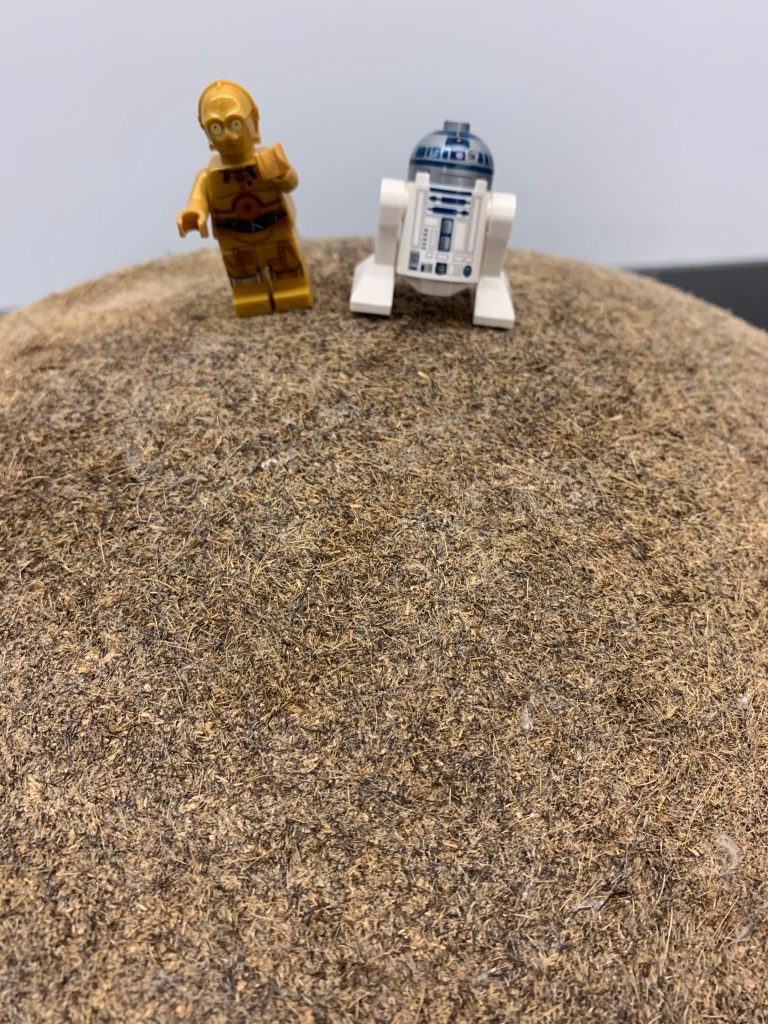
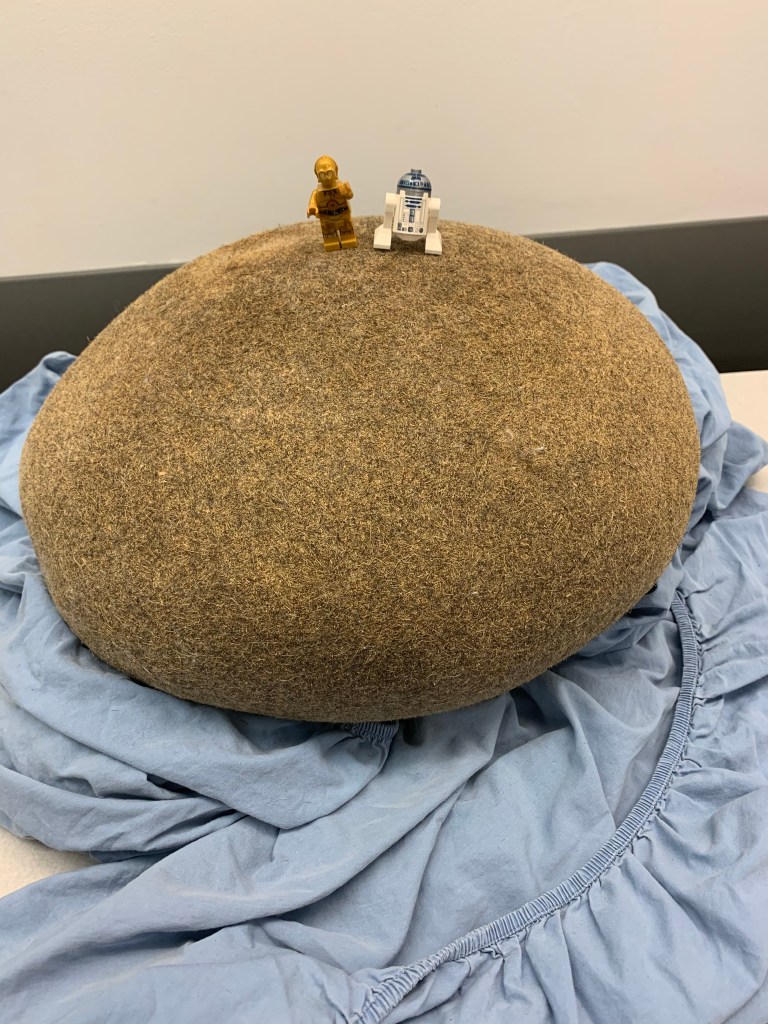
(beep boop beep). No R2 this is not a strange planet, this is a Bezoar taken from a cow.

A bezoar is a solid mass of indigestible material that accumulates in the digestive tract of animals. Bezoars usually form in the stomach but may form in the small intestine. They can even occur in children and adults. Bezoars are classified according to the material that forms them. Phytobezoars are composed of indigestible food fibers, such as cellulose. These fibers are found in fruits and vegetables. Trichobezoars are composed of hair or hair-like fibers, such as carpet or clothing fibers. Pharmacobezoars are composed of medications that don’t properly dissolve in the digestive tract.

Did you know, that bezoars were believed to have power of a universal antidote against any poison? Tradition held that a drinking glass which contained a bezoar would neutralize any poison poured into it. In fact, the word “bezoar” comes from the Persian pād-zahr, which literally means “antidote”.

Design a site like this with WordPress.com
Get started